


Gallery Ogata Ltd.
Rooted in Fukuoka’s Keyaki Street, the gallery has been presenting the latest in contemporary art for 23 years. From its quiet space, the gallery has delivered works that capture the sensibilities of the times. Eyes backed by experience and choices that trust in intuition. Veterans and young artists, local and global, past and future – Gallery Ogata is located at the crossroads of all these.
At AFAF 2025, we will be showcasing “art that reaches the viewer’s growth” along with talents that are attracting attention both from Japan and overseas.
Exhibitor Information
| Address |
〒810-0042 Chatelet Akasaka 2F, 2-4-3 Akasaka, Chuo-ku Fukuoka City JAPAN |
|---|---|
| Tel | 092-713-1835 |
| info@g-ogata.com | |
| Website | https://www.g-ogata.com |

Artists
KIKUTA NAOMI
Saori Doi
Nao Sano
Artworks
Purchase・Contact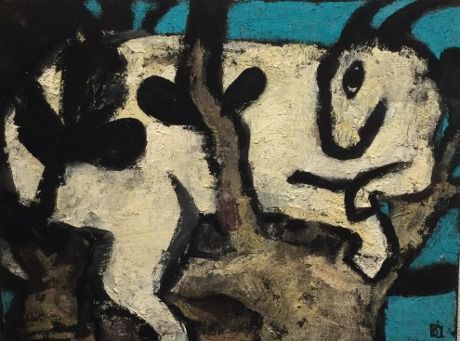
Saori Doi
Nap time
2025
Panel with cold-resistant fabric, plaster, water-dried, pigment
Painting
H30 × W40 × D4.5 cm
Gallery Ogata Ltd.
Detail- SECTION :
- Galleries
- BOOTH :
- W50
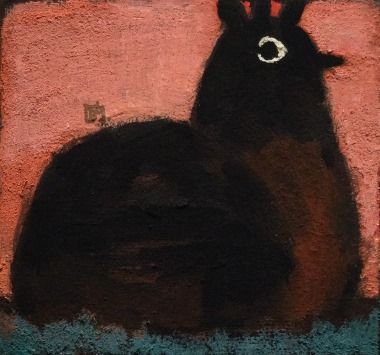
Saori Doi
Master
2025
Panel with cold-resistant fabric, plaster, water-dried, pigment
Painting
H14 × W15 × D4.5 cm
Gallery Ogata Ltd.
Detail- SECTION :
- Galleries
- BOOTH :
- W50
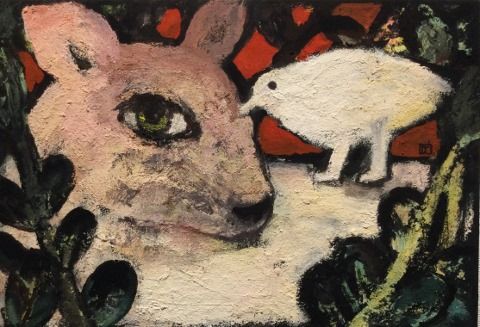
Saori Doi
Revelation
2025
Panel with cold-resistant fabric, plaster, water-dried, pigment
Painting
H31 × W45 × D4.5 cm
Gallery Ogata Ltd.
Detail- SECTION :
- Galleries
- BOOTH :
- W50
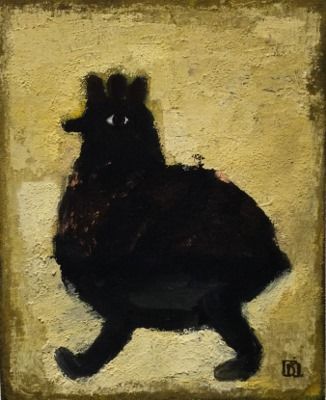
Saori Doi
Patrol
2025
Panel with cold-resistant fabric, plaster, water-dried, pigment
Painting
H25 × W20 × D4.5 cm
Gallery Ogata Ltd.
Detail- SECTION :
- Galleries
- BOOTH :
- W50
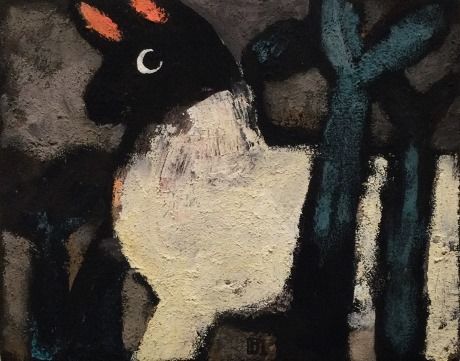
Saori Doi
My Garden
2025
Panel with cold-resistant fabric, plaster, water-dried, vermilion, pigments
Painting
H20 × W25 × D4.5 cm
Gallery Ogata Ltd.
Detail- SECTION :
- Galleries
- BOOTH :
- W50
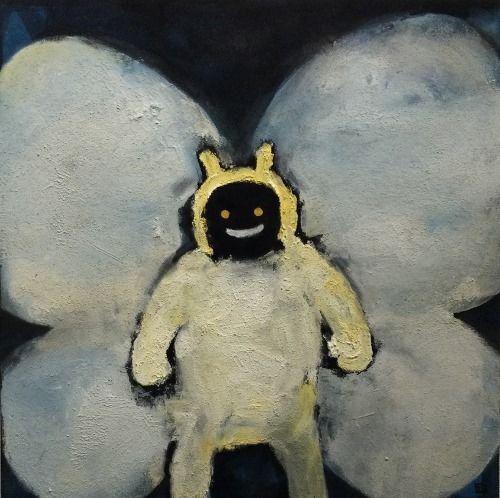
Saori Doi
Are you ready
2025
Panel with cold-resistant fabric, plaster, water-dried, vermilion, pigments
Painting
H60 × W60 × D4.5 cm
Gallery Ogata Ltd.
Detail- SECTION :
- Galleries
- BOOTH :
- W50
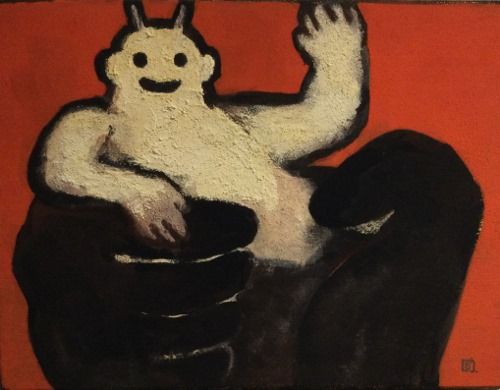
Saori Doi
This is OK
2025
Panel with cold-resistant fabric, plaster, water-dried, vermilion, pigments
Painting
H30 × W40 × D4.5 cm
Gallery Ogata Ltd.
Detail- SECTION :
- Galleries
- BOOTH :
- W50
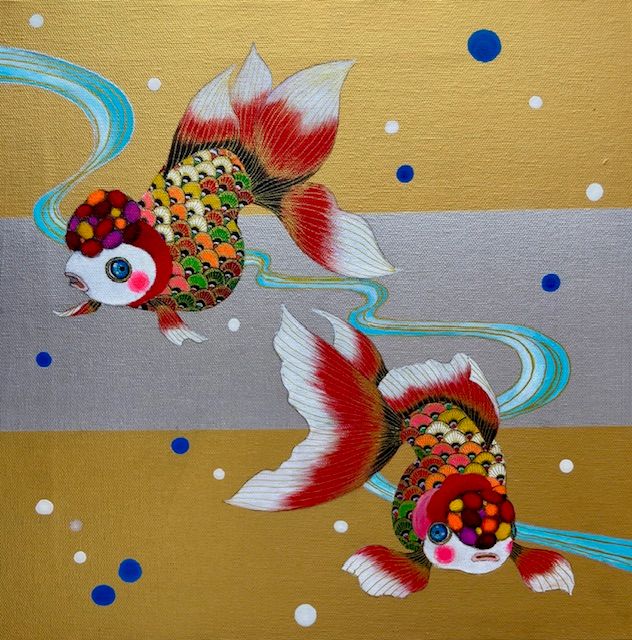
KIKUTA NAOMI
KINGYO2
2025
Acrylic, ink
Painting
H33.3 × W33.3 cm
Artist Profile
■ Biolgraphical Note
・Born in Kitakyushu city, Fukuoka, Japan
・Graduated from the Department of English and American literature , Tokyo Woman’s Christian University
・Completed MFA .Graduate School of Design,Kyushu University
■MONOGATARI
Folktales and stories are filled with mysterious events, often without clear logic, and at times even frightening. Yet, because they have been told with love, they have continued to offer people comfort, strength to live, and wisdom. That is why folktales have never disappeared and continue to be cherished.
When reading—or listening to—various stories, there are moments when a single sentence or even just one word captivates me, and an image suddenly rises to the surface. I wish to capture that fleeting moment and bring it onto the canvas.
Adding just the right amount of illustration to a story may help readers to slowly resonate with it, to spread the wings of their imagination. I hope people will find joy in quietly engaging with stories in this way.
With prayers that children all over the world may be surrounded by love, grow rich in spirit, and thrive in safety, I wish to share with you the world of my stories.
■KINGYOISM: (Kingyo is the Japanese word for goldfish)
People have bred kingyo from ancient times only to satisfy their own egocentric appreciation. Nevertheless, it is almost impossible to fix particular breeds, even though people have continued crossbreeding and the process of selection of specific mutational species. Kingyo happen to throw back ignoring people’s expectations. It is said that less than half of Kingyo grow as people want them to. Kingyo has lost its bodily habitus suitable for swimming because of people’s selfish breeding. Being forced to wear unnatural elegance, kingyo still refuses to be at the discretion of human beings. This must be a formidable Kingyo’s strategy (which is beyond the control of human beings).
People may think kingyo is just being watched, but it seems that kingyo meet people’s gaze squarely and gaze back straight from inside the aquarium or the countless small plastic bags hung from the eaves of pet shops. The moment when you feel so, you realize that it is rather human beings that are washed away by the flood of information, floating and drifting in the gigantic time and space.
If you sensed the gaze of kingyo, you could be enlightened by getting the feel of their eyes; then you must be able to feel, for even a moment, another self buried deep in everyday life that seems to pass automatically. Only through the kingyo’s eyes you will be able to see the true bonds with all life on earth and your ideal self.
■History and ecological characteristics of goldfish
There is a long history between human and goldfish. Red-colored Chinchui, which was found in the southern part ofChina about 1,700 years ago, is the original species of goldfish. Chinese people bred them in the ceramic bowls in the So period (about 400 years ago), and began to sort the varieties. Goldfish were introduced toJapan in the Muromachi period fromChina.
Goldfish have about 25 different varieties. There are two ways of breeding. One is by crossbreeding, and the other is by the artificial selections of the mutations. That goldfish have evolved from crucian carp has been proven by the morphological similarity, the same number and the type of the chromosomes, and the throwback by growing a pure culture. Each breed of goldfish has emerged in the relatively new age. Because of the instability of the gene, the selections are required to ensure the varietal characteristics. Many irregular forms appear even in the form of a tail fin that has been culled over the generations.
A tail fin analogous to that of crucian carp is called Funao, and nearly half of fry have this type of tail fin. Tsumami is another type that is also found in large numbers. Goldfish with these types of tail fin are unwanted; therefore you need selections to get rid of them. Body coloration starts to graduate from the initial crucian color to red or other colors about one month after hatching. Some of goldfish were improved to be viewed from the above and others were from the side.
○Jikin – Their epidermis is gradually destroyed by stripping the dorsal scales, and their color is changed by painting oxalic acid, glacial acetic acid, tartaric acid, salicylic acid, lime, and dilute hydrochloric acid. The shape of the tail fin is similar to a peacock. The probability of the emergence of this property is about 40 percent, if people select them for a long time.
○Choutengan – It is said that they were bred in deep ceramic bowls in the Qing court so the upper eyes have appeared.
○Ranchu – They lack the dorsal fin. Originally, this deficiency was caused by malformation. Ranchu has the curved and adhered spine. Because the tail is parallel to the axis of the body, it is clearly unsuitable for swimming. Only a handful of old fishes keep swimming smoothly.
○Tosakin – They have a warped tail that is inverted by crossbreeding and the appearance of the mutations. Young fishes are bred in the vessels like a mortar and forced to swim along the edge, and this unique tail is formed. They are not good swimmers and because of their sensitiveness to the water quality, it is very difficult to breed.
References
Matsui Yoshiichi:Kingyo , Hoikusya,1963
【 SOLO Exhibition 】
■ Art fair
・2014 Asia Contenporary Art Show(Hong Kong)
・2014 Art Kaouhsiung (Taiwan)
・2015 Affordable Art Fair Singapore (Singapore)
・2015 Asia Fukuoka Art Fair 2015(Fukuoka)
・2015 Art Kaouhsiung (Taiwan)
・2016 Art Kaouhsiung (Taiwan)
・2017 Asia Fukuoka Art Fair 2017(Fukuoka)
・2017Art Kaouhsiung (Taiwan)
・2018 Affordable Art Fair Hong Kong
・2018 Asia Fukuoka Art Fair 2018(Fukuoka)
■ Solo Exhibition
・2008/10 Naomi Kikuta Solo Exhibition, Goldfish Hour
Fukuoka Prefectural Museum of Art (Fukuoka)
・2012 /7 Naomi Kikuta Solo Exhibition, Cell
Reisen-Sou Renovation Museum (Fukuoka)
Panasonic Showroom, Mekiki Gallery (Fukuoka)
・2013/11 Naomi Kikuta Solo Exhibition, Rhizarians
Konya Gallery(Fukuoka)
・2014/2 Naomi Kikuta Solo Exhibition
Shonandai MY Gallery(Tokyo)
・2015/5 Naomi Kikuta Solo Exhibition
Shonandai MY Gallery (Tokyo)
・2016/7 Noomi Kikuta Solo Exhibition
Shonandai MY Gallery(Tokyo)
・2017/7 Naomi Kikuta Solo Exhibition
Gallery Ogata (Fukuoka)
・2018/4 Naomi Kikuta Solo Exhibition NELLA FANTASIA
Shonandai Gallery(Tokyo)
・2020/1 Naomi Kikuta Solo Exhibition FANTASIA,attoⅡ
s+arts (Tokyo)
■ Group Exhibition
・2011/11 Contemporary Art Exhibition 2011, Art League of Fukuokacity
Nishinihon City Bank Hall (Fukuoka)
・2011/11 Yotchan Biennale
Contemporary Art Center Osaka (Osaka)
・2011/02 Katayama laboratory exhibiton, School of Design, Kyushu University
Civic gallery, Fukuoka Art Museum (Fukuoka)
・2010/08 P & E2010 Group A
ARTCOURT Gallery Osaka (Osaka)
・2010/08 ART WAVE Fukuoka
Planning gallery, Asian Art Museum Fukuoka (Fukuoka)
・2010/02 Katayama laboratory exhibition,School of Design, Kyushu University
Civic gallery, Fukuoka Art Museum (Fukuoka)
・2009/10 Fukuoka City Art League Exhibition
Civic gallery,Fukuoka Art Museum (Fukuoka)
・2009/02 Katayama laboratory exhibition,School of Design,Kyushu University
Civic gallery, Fukuoka Art Museum (Fukuoka)
・2008/02 Contemporary Art Exhibition 2008, Art League of Fukuoka city
Nishinihon City Bank Hall (Fukuoka)
・2008/10 Fukuoka City Art League Exhibition
Special exhibition room A, Fukuoka Art Museum (Fukuoka)
・2008/10 The 24th Jonann-ku Art exhibition
Civic gallery,Fukuoka Art Museum (exhibition invitation) (Fukuoka)
・2008/01 The 5th Masuo Ikeda Memorial Art Exhibition
Ginza Yokyo Gallery (Tokyo)
・2008/03 The 5th Masuo Ikeda Memorial Art Exhibition
Contemporary Art Center (Osaka)
・2007/11 Contemporary Art Exhibition 2007, Art League ofFukuokacity
Gallery Maizuru (Fukuoka)
・2007/10 The 23th Jonan-ku Art exhibiton
Civic gallery,Fukuoka Art Museum (exhibition invitation) (Fukuoka)
・2007/10 Contemporary Art Exhibiton 2007, Art League of Fukuoka city
Nishinihon City Bank Hall (Fukuoka)
・2007/09 Fukuoka City Art exhibition
Special exhibition room A, Fukuoka Art Museum (Fukuoka)
・2007/06 The 1st Acrylic Art Award Exhibition 2007
Haradanomori Gallery, Hyogo Prefectural Museum (Grand Prize) (Kobe)
・2007/02 The 11th Liquitex Biennale Exhibition
Aoyama Spiral Garden (Tokyo)
・2006/11 The 22th Jonann-ku Art Exhibition
Civic gallery,Fukuoka Art Museum (exhibition invitation) (Fukuoka)
・2006/05 The 15th Shigeru Aoki Memorial Prize Exhibition
Ishibashi Museum of Art (Kurume,Fukuoka)
・2006/03 The 15th Shigeru Aoki Memorial Prize Exhibition
Koriyama City Museum (Fukushima)
・2006/01 The 4th Masuo Ikeda Memorial Art Exhibition (catalogs listing)
・2005/09 The 4th Shiobaru Project group Exhibition
Special exhibition room B, Fukuoka Art Museum (Fukuoka)
・2004/11 The 21th Jonan-ku Art Exhibition
Civic gallery, Fukuoka Art Museum (Mayor Award) (Fukuoka)
・2004/11 The 3rd Shiobaru Project group Exhibiton,
Special exhibition room B, Fukuoka Art Museum (Fukuoka)
・2003/11 The 2nd Shiobaru Project group Exhibition
IMS-Iris Gallery (Fukuoka)
・2003/03 The 1st Shiobaru Project group Exhibition
Fukuoka Asian Art Museum (Fukuoka)
Gallery Ogata Ltd.
Detail- SECTION :
- Galleries
- BOOTH :
- W50
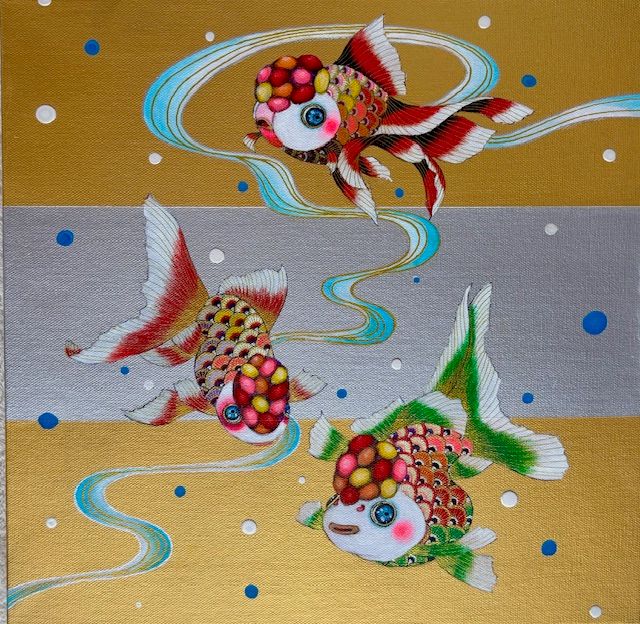
KIKUTA NAOMI
KINGYO3
2025
Acrylic, ink
Painting
H33.3 × W33.3 cm
Artist Profile
■ Biolgraphical Note
・Born in Kitakyushu city, Fukuoka, Japan
・Graduated from the Department of English and American literature , Tokyo Woman’s Christian University
・Completed MFA .Graduate School of Design,Kyushu University
■MONOGATARI
Folktales and stories are filled with mysterious events, often without clear logic, and at times even frightening. Yet, because they have been told with love, they have continued to offer people comfort, strength to live, and wisdom. That is why folktales have never disappeared and continue to be cherished.
When reading—or listening to—various stories, there are moments when a single sentence or even just one word captivates me, and an image suddenly rises to the surface. I wish to capture that fleeting moment and bring it onto the canvas.
Adding just the right amount of illustration to a story may help readers to slowly resonate with it, to spread the wings of their imagination. I hope people will find joy in quietly engaging with stories in this way.
With prayers that children all over the world may be surrounded by love, grow rich in spirit, and thrive in safety, I wish to share with you the world of my stories.
■KINGYOISM: (Kingyo is the Japanese word for goldfish)
People have bred kingyo from ancient times only to satisfy their own egocentric appreciation. Nevertheless, it is almost impossible to fix particular breeds, even though people have continued crossbreeding and the process of selection of specific mutational species. Kingyo happen to throw back ignoring people’s expectations. It is said that less than half of Kingyo grow as people want them to. Kingyo has lost its bodily habitus suitable for swimming because of people’s selfish breeding. Being forced to wear unnatural elegance, kingyo still refuses to be at the discretion of human beings. This must be a formidable Kingyo’s strategy (which is beyond the control of human beings).
People may think kingyo is just being watched, but it seems that kingyo meet people’s gaze squarely and gaze back straight from inside the aquarium or the countless small plastic bags hung from the eaves of pet shops. The moment when you feel so, you realize that it is rather human beings that are washed away by the flood of information, floating and drifting in the gigantic time and space.
If you sensed the gaze of kingyo, you could be enlightened by getting the feel of their eyes; then you must be able to feel, for even a moment, another self buried deep in everyday life that seems to pass automatically. Only through the kingyo’s eyes you will be able to see the true bonds with all life on earth and your ideal self.
■History and ecological characteristics of goldfish
There is a long history between human and goldfish. Red-colored Chinchui, which was found in the southern part ofChina about 1,700 years ago, is the original species of goldfish. Chinese people bred them in the ceramic bowls in the So period (about 400 years ago), and began to sort the varieties. Goldfish were introduced toJapan in the Muromachi period fromChina.
Goldfish have about 25 different varieties. There are two ways of breeding. One is by crossbreeding, and the other is by the artificial selections of the mutations. That goldfish have evolved from crucian carp has been proven by the morphological similarity, the same number and the type of the chromosomes, and the throwback by growing a pure culture. Each breed of goldfish has emerged in the relatively new age. Because of the instability of the gene, the selections are required to ensure the varietal characteristics. Many irregular forms appear even in the form of a tail fin that has been culled over the generations.
A tail fin analogous to that of crucian carp is called Funao, and nearly half of fry have this type of tail fin. Tsumami is another type that is also found in large numbers. Goldfish with these types of tail fin are unwanted; therefore you need selections to get rid of them. Body coloration starts to graduate from the initial crucian color to red or other colors about one month after hatching. Some of goldfish were improved to be viewed from the above and others were from the side.
○Jikin – Their epidermis is gradually destroyed by stripping the dorsal scales, and their color is changed by painting oxalic acid, glacial acetic acid, tartaric acid, salicylic acid, lime, and dilute hydrochloric acid. The shape of the tail fin is similar to a peacock. The probability of the emergence of this property is about 40 percent, if people select them for a long time.
○Choutengan – It is said that they were bred in deep ceramic bowls in the Qing court so the upper eyes have appeared.
○Ranchu – They lack the dorsal fin. Originally, this deficiency was caused by malformation. Ranchu has the curved and adhered spine. Because the tail is parallel to the axis of the body, it is clearly unsuitable for swimming. Only a handful of old fishes keep swimming smoothly.
○Tosakin – They have a warped tail that is inverted by crossbreeding and the appearance of the mutations. Young fishes are bred in the vessels like a mortar and forced to swim along the edge, and this unique tail is formed. They are not good swimmers and because of their sensitiveness to the water quality, it is very difficult to breed.
References
Matsui Yoshiichi:Kingyo , Hoikusya,1963
【 SOLO Exhibition 】
■ Art fair
・2014 Asia Contenporary Art Show(Hong Kong)
・2014 Art Kaouhsiung (Taiwan)
・2015 Affordable Art Fair Singapore (Singapore)
・2015 Asia Fukuoka Art Fair 2015(Fukuoka)
・2015 Art Kaouhsiung (Taiwan)
・2016 Art Kaouhsiung (Taiwan)
・2017 Asia Fukuoka Art Fair 2017(Fukuoka)
・2017Art Kaouhsiung (Taiwan)
・2018 Affordable Art Fair Hong Kong
・2018 Asia Fukuoka Art Fair 2018(Fukuoka)
■ Solo Exhibition
・2008/10 Naomi Kikuta Solo Exhibition, Goldfish Hour
Fukuoka Prefectural Museum of Art (Fukuoka)
・2012 /7 Naomi Kikuta Solo Exhibition, Cell
Reisen-Sou Renovation Museum (Fukuoka)
Panasonic Showroom, Mekiki Gallery (Fukuoka)
・2013/11 Naomi Kikuta Solo Exhibition, Rhizarians
Konya Gallery(Fukuoka)
・2014/2 Naomi Kikuta Solo Exhibition
Shonandai MY Gallery(Tokyo)
・2015/5 Naomi Kikuta Solo Exhibition
Shonandai MY Gallery (Tokyo)
・2016/7 Noomi Kikuta Solo Exhibition
Shonandai MY Gallery(Tokyo)
・2017/7 Naomi Kikuta Solo Exhibition
Gallery Ogata (Fukuoka)
・2018/4 Naomi Kikuta Solo Exhibition NELLA FANTASIA
Shonandai Gallery(Tokyo)
・2020/1 Naomi Kikuta Solo Exhibition FANTASIA,attoⅡ
s+arts (Tokyo)
■ Group Exhibition
・2011/11 Contemporary Art Exhibition 2011, Art League of Fukuokacity
Nishinihon City Bank Hall (Fukuoka)
・2011/11 Yotchan Biennale
Contemporary Art Center Osaka (Osaka)
・2011/02 Katayama laboratory exhibiton, School of Design, Kyushu University
Civic gallery, Fukuoka Art Museum (Fukuoka)
・2010/08 P & E2010 Group A
ARTCOURT Gallery Osaka (Osaka)
・2010/08 ART WAVE Fukuoka
Planning gallery, Asian Art Museum Fukuoka (Fukuoka)
・2010/02 Katayama laboratory exhibition,School of Design, Kyushu University
Civic gallery, Fukuoka Art Museum (Fukuoka)
・2009/10 Fukuoka City Art League Exhibition
Civic gallery,Fukuoka Art Museum (Fukuoka)
・2009/02 Katayama laboratory exhibition,School of Design,Kyushu University
Civic gallery, Fukuoka Art Museum (Fukuoka)
・2008/02 Contemporary Art Exhibition 2008, Art League of Fukuoka city
Nishinihon City Bank Hall (Fukuoka)
・2008/10 Fukuoka City Art League Exhibition
Special exhibition room A, Fukuoka Art Museum (Fukuoka)
・2008/10 The 24th Jonann-ku Art exhibition
Civic gallery,Fukuoka Art Museum (exhibition invitation) (Fukuoka)
・2008/01 The 5th Masuo Ikeda Memorial Art Exhibition
Ginza Yokyo Gallery (Tokyo)
・2008/03 The 5th Masuo Ikeda Memorial Art Exhibition
Contemporary Art Center (Osaka)
・2007/11 Contemporary Art Exhibition 2007, Art League ofFukuokacity
Gallery Maizuru (Fukuoka)
・2007/10 The 23th Jonan-ku Art exhibiton
Civic gallery,Fukuoka Art Museum (exhibition invitation) (Fukuoka)
・2007/10 Contemporary Art Exhibiton 2007, Art League of Fukuoka city
Nishinihon City Bank Hall (Fukuoka)
・2007/09 Fukuoka City Art exhibition
Special exhibition room A, Fukuoka Art Museum (Fukuoka)
・2007/06 The 1st Acrylic Art Award Exhibition 2007
Haradanomori Gallery, Hyogo Prefectural Museum (Grand Prize) (Kobe)
・2007/02 The 11th Liquitex Biennale Exhibition
Aoyama Spiral Garden (Tokyo)
・2006/11 The 22th Jonann-ku Art Exhibition
Civic gallery,Fukuoka Art Museum (exhibition invitation) (Fukuoka)
・2006/05 The 15th Shigeru Aoki Memorial Prize Exhibition
Ishibashi Museum of Art (Kurume,Fukuoka)
・2006/03 The 15th Shigeru Aoki Memorial Prize Exhibition
Koriyama City Museum (Fukushima)
・2006/01 The 4th Masuo Ikeda Memorial Art Exhibition (catalogs listing)
・2005/09 The 4th Shiobaru Project group Exhibition
Special exhibition room B, Fukuoka Art Museum (Fukuoka)
・2004/11 The 21th Jonan-ku Art Exhibition
Civic gallery, Fukuoka Art Museum (Mayor Award) (Fukuoka)
・2004/11 The 3rd Shiobaru Project group Exhibiton,
Special exhibition room B, Fukuoka Art Museum (Fukuoka)
・2003/11 The 2nd Shiobaru Project group Exhibition
IMS-Iris Gallery (Fukuoka)
・2003/03 The 1st Shiobaru Project group Exhibition
Fukuoka Asian Art Museum (Fukuoka)
Gallery Ogata Ltd.
Detail- SECTION :
- Galleries
- BOOTH :
- W50
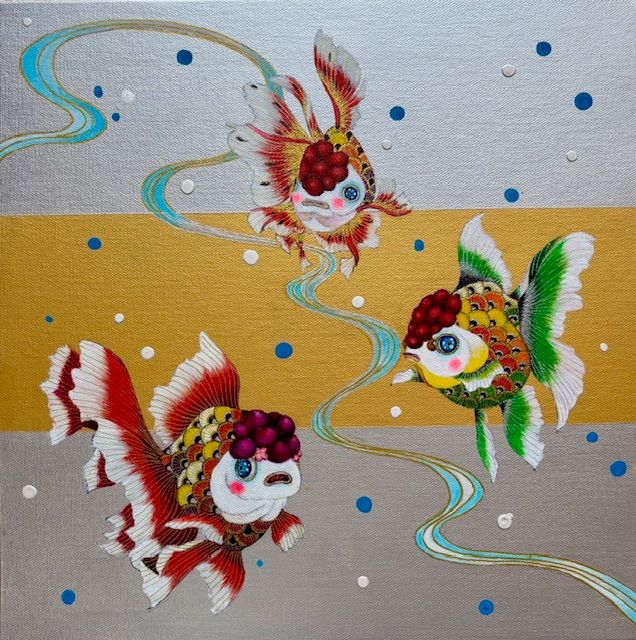
KIKUTA NAOMI
KINGYO
2025
Acrylic, ink
Painting
H33.3 × W33.3 cm
Artist Profile
■ Biolgraphical Note
・Born in Kitakyushu city, Fukuoka, Japan
・Graduated from the Department of English and American literature , Tokyo Woman’s Christian University
・Completed MFA .Graduate School of Design,Kyushu University
■MONOGATARI
Folktales and stories are filled with mysterious events, often without clear logic, and at times even frightening. Yet, because they have been told with love, they have continued to offer people comfort, strength to live, and wisdom. That is why folktales have never disappeared and continue to be cherished.
When reading—or listening to—various stories, there are moments when a single sentence or even just one word captivates me, and an image suddenly rises to the surface. I wish to capture that fleeting moment and bring it onto the canvas.
Adding just the right amount of illustration to a story may help readers to slowly resonate with it, to spread the wings of their imagination. I hope people will find joy in quietly engaging with stories in this way.
With prayers that children all over the world may be surrounded by love, grow rich in spirit, and thrive in safety, I wish to share with you the world of my stories.
■KINGYOISM: (Kingyo is the Japanese word for goldfish)
People have bred kingyo from ancient times only to satisfy their own egocentric appreciation. Nevertheless, it is almost impossible to fix particular breeds, even though people have continued crossbreeding and the process of selection of specific mutational species. Kingyo happen to throw back ignoring people’s expectations. It is said that less than half of Kingyo grow as people want them to. Kingyo has lost its bodily habitus suitable for swimming because of people’s selfish breeding. Being forced to wear unnatural elegance, kingyo still refuses to be at the discretion of human beings. This must be a formidable Kingyo’s strategy (which is beyond the control of human beings).
People may think kingyo is just being watched, but it seems that kingyo meet people’s gaze squarely and gaze back straight from inside the aquarium or the countless small plastic bags hung from the eaves of pet shops. The moment when you feel so, you realize that it is rather human beings that are washed away by the flood of information, floating and drifting in the gigantic time and space.
If you sensed the gaze of kingyo, you could be enlightened by getting the feel of their eyes; then you must be able to feel, for even a moment, another self buried deep in everyday life that seems to pass automatically. Only through the kingyo’s eyes you will be able to see the true bonds with all life on earth and your ideal self.
■History and ecological characteristics of goldfish
There is a long history between human and goldfish. Red-colored Chinchui, which was found in the southern part ofChina about 1,700 years ago, is the original species of goldfish. Chinese people bred them in the ceramic bowls in the So period (about 400 years ago), and began to sort the varieties. Goldfish were introduced toJapan in the Muromachi period fromChina.
Goldfish have about 25 different varieties. There are two ways of breeding. One is by crossbreeding, and the other is by the artificial selections of the mutations. That goldfish have evolved from crucian carp has been proven by the morphological similarity, the same number and the type of the chromosomes, and the throwback by growing a pure culture. Each breed of goldfish has emerged in the relatively new age. Because of the instability of the gene, the selections are required to ensure the varietal characteristics. Many irregular forms appear even in the form of a tail fin that has been culled over the generations.
A tail fin analogous to that of crucian carp is called Funao, and nearly half of fry have this type of tail fin. Tsumami is another type that is also found in large numbers. Goldfish with these types of tail fin are unwanted; therefore you need selections to get rid of them. Body coloration starts to graduate from the initial crucian color to red or other colors about one month after hatching. Some of goldfish were improved to be viewed from the above and others were from the side.
○Jikin – Their epidermis is gradually destroyed by stripping the dorsal scales, and their color is changed by painting oxalic acid, glacial acetic acid, tartaric acid, salicylic acid, lime, and dilute hydrochloric acid. The shape of the tail fin is similar to a peacock. The probability of the emergence of this property is about 40 percent, if people select them for a long time.
○Choutengan – It is said that they were bred in deep ceramic bowls in the Qing court so the upper eyes have appeared.
○Ranchu – They lack the dorsal fin. Originally, this deficiency was caused by malformation. Ranchu has the curved and adhered spine. Because the tail is parallel to the axis of the body, it is clearly unsuitable for swimming. Only a handful of old fishes keep swimming smoothly.
○Tosakin – They have a warped tail that is inverted by crossbreeding and the appearance of the mutations. Young fishes are bred in the vessels like a mortar and forced to swim along the edge, and this unique tail is formed. They are not good swimmers and because of their sensitiveness to the water quality, it is very difficult to breed.
References
Matsui Yoshiichi:Kingyo , Hoikusya,1963
【 SOLO Exhibition 】
■ Art fair
・2014 Asia Contenporary Art Show(Hong Kong)
・2014 Art Kaouhsiung (Taiwan)
・2015 Affordable Art Fair Singapore (Singapore)
・2015 Asia Fukuoka Art Fair 2015(Fukuoka)
・2015 Art Kaouhsiung (Taiwan)
・2016 Art Kaouhsiung (Taiwan)
・2017 Asia Fukuoka Art Fair 2017(Fukuoka)
・2017Art Kaouhsiung (Taiwan)
・2018 Affordable Art Fair Hong Kong
・2018 Asia Fukuoka Art Fair 2018(Fukuoka)
■ Solo Exhibition
・2008/10 Naomi Kikuta Solo Exhibition, Goldfish Hour
Fukuoka Prefectural Museum of Art (Fukuoka)
・2012 /7 Naomi Kikuta Solo Exhibition, Cell
Reisen-Sou Renovation Museum (Fukuoka)
Panasonic Showroom, Mekiki Gallery (Fukuoka)
・2013/11 Naomi Kikuta Solo Exhibition, Rhizarians
Konya Gallery(Fukuoka)
・2014/2 Naomi Kikuta Solo Exhibition
Shonandai MY Gallery(Tokyo)
・2015/5 Naomi Kikuta Solo Exhibition
Shonandai MY Gallery (Tokyo)
・2016/7 Noomi Kikuta Solo Exhibition
Shonandai MY Gallery(Tokyo)
・2017/7 Naomi Kikuta Solo Exhibition
Gallery Ogata (Fukuoka)
・2018/4 Naomi Kikuta Solo Exhibition NELLA FANTASIA
Shonandai Gallery(Tokyo)
・2020/1 Naomi Kikuta Solo Exhibition FANTASIA,attoⅡ
s+arts (Tokyo)
■ Group Exhibition
・2011/11 Contemporary Art Exhibition 2011, Art League of Fukuokacity
Nishinihon City Bank Hall (Fukuoka)
・2011/11 Yotchan Biennale
Contemporary Art Center Osaka (Osaka)
・2011/02 Katayama laboratory exhibiton, School of Design, Kyushu University
Civic gallery, Fukuoka Art Museum (Fukuoka)
・2010/08 P & E2010 Group A
ARTCOURT Gallery Osaka (Osaka)
・2010/08 ART WAVE Fukuoka
Planning gallery, Asian Art Museum Fukuoka (Fukuoka)
・2010/02 Katayama laboratory exhibition,School of Design, Kyushu University
Civic gallery, Fukuoka Art Museum (Fukuoka)
・2009/10 Fukuoka City Art League Exhibition
Civic gallery,Fukuoka Art Museum (Fukuoka)
・2009/02 Katayama laboratory exhibition,School of Design,Kyushu University
Civic gallery, Fukuoka Art Museum (Fukuoka)
・2008/02 Contemporary Art Exhibition 2008, Art League of Fukuoka city
Nishinihon City Bank Hall (Fukuoka)
・2008/10 Fukuoka City Art League Exhibition
Special exhibition room A, Fukuoka Art Museum (Fukuoka)
・2008/10 The 24th Jonann-ku Art exhibition
Civic gallery,Fukuoka Art Museum (exhibition invitation) (Fukuoka)
・2008/01 The 5th Masuo Ikeda Memorial Art Exhibition
Ginza Yokyo Gallery (Tokyo)
・2008/03 The 5th Masuo Ikeda Memorial Art Exhibition
Contemporary Art Center (Osaka)
・2007/11 Contemporary Art Exhibition 2007, Art League ofFukuokacity
Gallery Maizuru (Fukuoka)
・2007/10 The 23th Jonan-ku Art exhibiton
Civic gallery,Fukuoka Art Museum (exhibition invitation) (Fukuoka)
・2007/10 Contemporary Art Exhibiton 2007, Art League of Fukuoka city
Nishinihon City Bank Hall (Fukuoka)
・2007/09 Fukuoka City Art exhibition
Special exhibition room A, Fukuoka Art Museum (Fukuoka)
・2007/06 The 1st Acrylic Art Award Exhibition 2007
Haradanomori Gallery, Hyogo Prefectural Museum (Grand Prize) (Kobe)
・2007/02 The 11th Liquitex Biennale Exhibition
Aoyama Spiral Garden (Tokyo)
・2006/11 The 22th Jonann-ku Art Exhibition
Civic gallery,Fukuoka Art Museum (exhibition invitation) (Fukuoka)
・2006/05 The 15th Shigeru Aoki Memorial Prize Exhibition
Ishibashi Museum of Art (Kurume,Fukuoka)
・2006/03 The 15th Shigeru Aoki Memorial Prize Exhibition
Koriyama City Museum (Fukushima)
・2006/01 The 4th Masuo Ikeda Memorial Art Exhibition (catalogs listing)
・2005/09 The 4th Shiobaru Project group Exhibition
Special exhibition room B, Fukuoka Art Museum (Fukuoka)
・2004/11 The 21th Jonan-ku Art Exhibition
Civic gallery, Fukuoka Art Museum (Mayor Award) (Fukuoka)
・2004/11 The 3rd Shiobaru Project group Exhibiton,
Special exhibition room B, Fukuoka Art Museum (Fukuoka)
・2003/11 The 2nd Shiobaru Project group Exhibition
IMS-Iris Gallery (Fukuoka)
・2003/03 The 1st Shiobaru Project group Exhibition
Fukuoka Asian Art Museum (Fukuoka)
Gallery Ogata Ltd.
Detail- SECTION :
- Galleries
- BOOTH :
- W50
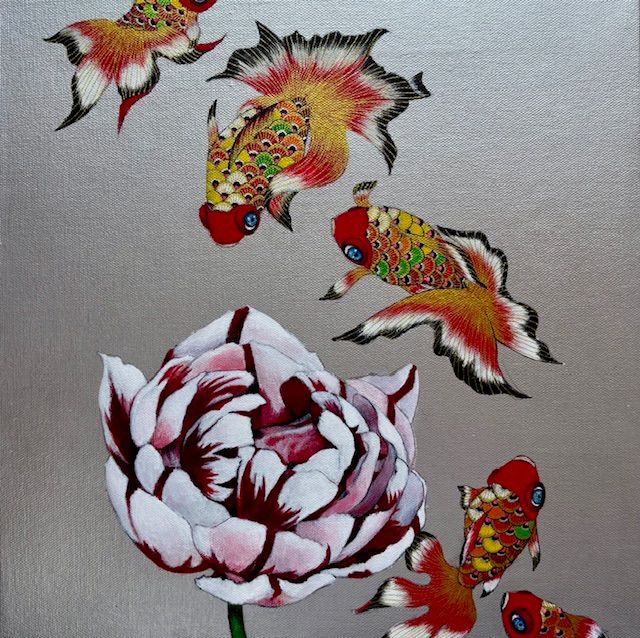
KIKUTA NAOMI
The Thumbelina's Dream
2025
acrylic
Painting
H33.3 × W33.3 cm
Artist Profile
■ Biolgraphical Note
・Born in Kitakyushu city, Fukuoka, Japan
・Graduated from the Department of English and American literature , Tokyo Woman’s Christian University
・Completed MFA .Graduate School of Design,Kyushu University
■MONOGATARI
Folktales and stories are filled with mysterious events, often without clear logic, and at times even frightening. Yet, because they have been told with love, they have continued to offer people comfort, strength to live, and wisdom. That is why folktales have never disappeared and continue to be cherished.
When reading—or listening to—various stories, there are moments when a single sentence or even just one word captivates me, and an image suddenly rises to the surface. I wish to capture that fleeting moment and bring it onto the canvas.
Adding just the right amount of illustration to a story may help readers to slowly resonate with it, to spread the wings of their imagination. I hope people will find joy in quietly engaging with stories in this way.
With prayers that children all over the world may be surrounded by love, grow rich in spirit, and thrive in safety, I wish to share with you the world of my stories.
■KINGYOISM: (Kingyo is the Japanese word for goldfish)
People have bred kingyo from ancient times only to satisfy their own egocentric appreciation. Nevertheless, it is almost impossible to fix particular breeds, even though people have continued crossbreeding and the process of selection of specific mutational species. Kingyo happen to throw back ignoring people’s expectations. It is said that less than half of Kingyo grow as people want them to. Kingyo has lost its bodily habitus suitable for swimming because of people’s selfish breeding. Being forced to wear unnatural elegance, kingyo still refuses to be at the discretion of human beings. This must be a formidable Kingyo’s strategy (which is beyond the control of human beings).
People may think kingyo is just being watched, but it seems that kingyo meet people’s gaze squarely and gaze back straight from inside the aquarium or the countless small plastic bags hung from the eaves of pet shops. The moment when you feel so, you realize that it is rather human beings that are washed away by the flood of information, floating and drifting in the gigantic time and space.
If you sensed the gaze of kingyo, you could be enlightened by getting the feel of their eyes; then you must be able to feel, for even a moment, another self buried deep in everyday life that seems to pass automatically. Only through the kingyo’s eyes you will be able to see the true bonds with all life on earth and your ideal self.
■History and ecological characteristics of goldfish
There is a long history between human and goldfish. Red-colored Chinchui, which was found in the southern part ofChina about 1,700 years ago, is the original species of goldfish. Chinese people bred them in the ceramic bowls in the So period (about 400 years ago), and began to sort the varieties. Goldfish were introduced toJapan in the Muromachi period fromChina.
Goldfish have about 25 different varieties. There are two ways of breeding. One is by crossbreeding, and the other is by the artificial selections of the mutations. That goldfish have evolved from crucian carp has been proven by the morphological similarity, the same number and the type of the chromosomes, and the throwback by growing a pure culture. Each breed of goldfish has emerged in the relatively new age. Because of the instability of the gene, the selections are required to ensure the varietal characteristics. Many irregular forms appear even in the form of a tail fin that has been culled over the generations.
A tail fin analogous to that of crucian carp is called Funao, and nearly half of fry have this type of tail fin. Tsumami is another type that is also found in large numbers. Goldfish with these types of tail fin are unwanted; therefore you need selections to get rid of them. Body coloration starts to graduate from the initial crucian color to red or other colors about one month after hatching. Some of goldfish were improved to be viewed from the above and others were from the side.
○Jikin – Their epidermis is gradually destroyed by stripping the dorsal scales, and their color is changed by painting oxalic acid, glacial acetic acid, tartaric acid, salicylic acid, lime, and dilute hydrochloric acid. The shape of the tail fin is similar to a peacock. The probability of the emergence of this property is about 40 percent, if people select them for a long time.
○Choutengan – It is said that they were bred in deep ceramic bowls in the Qing court so the upper eyes have appeared.
○Ranchu – They lack the dorsal fin. Originally, this deficiency was caused by malformation. Ranchu has the curved and adhered spine. Because the tail is parallel to the axis of the body, it is clearly unsuitable for swimming. Only a handful of old fishes keep swimming smoothly.
○Tosakin – They have a warped tail that is inverted by crossbreeding and the appearance of the mutations. Young fishes are bred in the vessels like a mortar and forced to swim along the edge, and this unique tail is formed. They are not good swimmers and because of their sensitiveness to the water quality, it is very difficult to breed.
References
Matsui Yoshiichi:Kingyo , Hoikusya,1963
【 SOLO Exhibition 】
■ Art fair
・2014 Asia Contenporary Art Show(Hong Kong)
・2014 Art Kaouhsiung (Taiwan)
・2015 Affordable Art Fair Singapore (Singapore)
・2015 Asia Fukuoka Art Fair 2015(Fukuoka)
・2015 Art Kaouhsiung (Taiwan)
・2016 Art Kaouhsiung (Taiwan)
・2017 Asia Fukuoka Art Fair 2017(Fukuoka)
・2017Art Kaouhsiung (Taiwan)
・2018 Affordable Art Fair Hong Kong
・2018 Asia Fukuoka Art Fair 2018(Fukuoka)
■ Solo Exhibition
・2008/10 Naomi Kikuta Solo Exhibition, Goldfish Hour
Fukuoka Prefectural Museum of Art (Fukuoka)
・2012 /7 Naomi Kikuta Solo Exhibition, Cell
Reisen-Sou Renovation Museum (Fukuoka)
Panasonic Showroom, Mekiki Gallery (Fukuoka)
・2013/11 Naomi Kikuta Solo Exhibition, Rhizarians
Konya Gallery(Fukuoka)
・2014/2 Naomi Kikuta Solo Exhibition
Shonandai MY Gallery(Tokyo)
・2015/5 Naomi Kikuta Solo Exhibition
Shonandai MY Gallery (Tokyo)
・2016/7 Noomi Kikuta Solo Exhibition
Shonandai MY Gallery(Tokyo)
・2017/7 Naomi Kikuta Solo Exhibition
Gallery Ogata (Fukuoka)
・2018/4 Naomi Kikuta Solo Exhibition NELLA FANTASIA
Shonandai Gallery(Tokyo)
・2020/1 Naomi Kikuta Solo Exhibition FANTASIA,attoⅡ
s+arts (Tokyo)
■ Group Exhibition
・2011/11 Contemporary Art Exhibition 2011, Art League of Fukuokacity
Nishinihon City Bank Hall (Fukuoka)
・2011/11 Yotchan Biennale
Contemporary Art Center Osaka (Osaka)
・2011/02 Katayama laboratory exhibiton, School of Design, Kyushu University
Civic gallery, Fukuoka Art Museum (Fukuoka)
・2010/08 P & E2010 Group A
ARTCOURT Gallery Osaka (Osaka)
・2010/08 ART WAVE Fukuoka
Planning gallery, Asian Art Museum Fukuoka (Fukuoka)
・2010/02 Katayama laboratory exhibition,School of Design, Kyushu University
Civic gallery, Fukuoka Art Museum (Fukuoka)
・2009/10 Fukuoka City Art League Exhibition
Civic gallery,Fukuoka Art Museum (Fukuoka)
・2009/02 Katayama laboratory exhibition,School of Design,Kyushu University
Civic gallery, Fukuoka Art Museum (Fukuoka)
・2008/02 Contemporary Art Exhibition 2008, Art League of Fukuoka city
Nishinihon City Bank Hall (Fukuoka)
・2008/10 Fukuoka City Art League Exhibition
Special exhibition room A, Fukuoka Art Museum (Fukuoka)
・2008/10 The 24th Jonann-ku Art exhibition
Civic gallery,Fukuoka Art Museum (exhibition invitation) (Fukuoka)
・2008/01 The 5th Masuo Ikeda Memorial Art Exhibition
Ginza Yokyo Gallery (Tokyo)
・2008/03 The 5th Masuo Ikeda Memorial Art Exhibition
Contemporary Art Center (Osaka)
・2007/11 Contemporary Art Exhibition 2007, Art League ofFukuokacity
Gallery Maizuru (Fukuoka)
・2007/10 The 23th Jonan-ku Art exhibiton
Civic gallery,Fukuoka Art Museum (exhibition invitation) (Fukuoka)
・2007/10 Contemporary Art Exhibiton 2007, Art League of Fukuoka city
Nishinihon City Bank Hall (Fukuoka)
・2007/09 Fukuoka City Art exhibition
Special exhibition room A, Fukuoka Art Museum (Fukuoka)
・2007/06 The 1st Acrylic Art Award Exhibition 2007
Haradanomori Gallery, Hyogo Prefectural Museum (Grand Prize) (Kobe)
・2007/02 The 11th Liquitex Biennale Exhibition
Aoyama Spiral Garden (Tokyo)
・2006/11 The 22th Jonann-ku Art Exhibition
Civic gallery,Fukuoka Art Museum (exhibition invitation) (Fukuoka)
・2006/05 The 15th Shigeru Aoki Memorial Prize Exhibition
Ishibashi Museum of Art (Kurume,Fukuoka)
・2006/03 The 15th Shigeru Aoki Memorial Prize Exhibition
Koriyama City Museum (Fukushima)
・2006/01 The 4th Masuo Ikeda Memorial Art Exhibition (catalogs listing)
・2005/09 The 4th Shiobaru Project group Exhibition
Special exhibition room B, Fukuoka Art Museum (Fukuoka)
・2004/11 The 21th Jonan-ku Art Exhibition
Civic gallery, Fukuoka Art Museum (Mayor Award) (Fukuoka)
・2004/11 The 3rd Shiobaru Project group Exhibiton,
Special exhibition room B, Fukuoka Art Museum (Fukuoka)
・2003/11 The 2nd Shiobaru Project group Exhibition
IMS-Iris Gallery (Fukuoka)
・2003/03 The 1st Shiobaru Project group Exhibition
Fukuoka Asian Art Museum (Fukuoka)
Gallery Ogata Ltd.
Detail- SECTION :
- Galleries
- BOOTH :
- W50
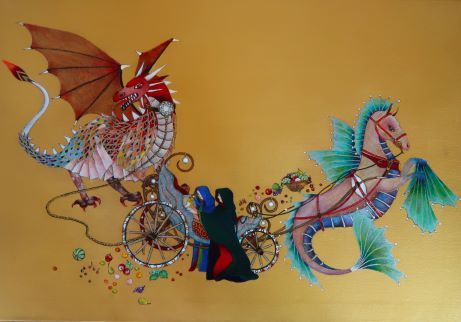
KIKUTA NAOMI
The Little Princess's Journey
2025
acrylic
Painting
H72.7 × W50 cm
Artist Profile
■ Biolgraphical Note
・Born in Kitakyushu city, Fukuoka, Japan
・Graduated from the Department of English and American literature , Tokyo Woman’s Christian University
・Completed MFA .Graduate School of Design,Kyushu University
■MONOGATARI
Folktales and stories are filled with mysterious events, often without clear logic, and at times even frightening. Yet, because they have been told with love, they have continued to offer people comfort, strength to live, and wisdom. That is why folktales have never disappeared and continue to be cherished.
When reading—or listening to—various stories, there are moments when a single sentence or even just one word captivates me, and an image suddenly rises to the surface. I wish to capture that fleeting moment and bring it onto the canvas.
Adding just the right amount of illustration to a story may help readers to slowly resonate with it, to spread the wings of their imagination. I hope people will find joy in quietly engaging with stories in this way.
With prayers that children all over the world may be surrounded by love, grow rich in spirit, and thrive in safety, I wish to share with you the world of my stories.
■KINGYOISM: (Kingyo is the Japanese word for goldfish)
People have bred kingyo from ancient times only to satisfy their own egocentric appreciation. Nevertheless, it is almost impossible to fix particular breeds, even though people have continued crossbreeding and the process of selection of specific mutational species. Kingyo happen to throw back ignoring people’s expectations. It is said that less than half of Kingyo grow as people want them to. Kingyo has lost its bodily habitus suitable for swimming because of people’s selfish breeding. Being forced to wear unnatural elegance, kingyo still refuses to be at the discretion of human beings. This must be a formidable Kingyo’s strategy (which is beyond the control of human beings).
People may think kingyo is just being watched, but it seems that kingyo meet people’s gaze squarely and gaze back straight from inside the aquarium or the countless small plastic bags hung from the eaves of pet shops. The moment when you feel so, you realize that it is rather human beings that are washed away by the flood of information, floating and drifting in the gigantic time and space.
If you sensed the gaze of kingyo, you could be enlightened by getting the feel of their eyes; then you must be able to feel, for even a moment, another self buried deep in everyday life that seems to pass automatically. Only through the kingyo’s eyes you will be able to see the true bonds with all life on earth and your ideal self.
■History and ecological characteristics of goldfish
There is a long history between human and goldfish. Red-colored Chinchui, which was found in the southern part ofChina about 1,700 years ago, is the original species of goldfish. Chinese people bred them in the ceramic bowls in the So period (about 400 years ago), and began to sort the varieties. Goldfish were introduced toJapan in the Muromachi period fromChina.
Goldfish have about 25 different varieties. There are two ways of breeding. One is by crossbreeding, and the other is by the artificial selections of the mutations. That goldfish have evolved from crucian carp has been proven by the morphological similarity, the same number and the type of the chromosomes, and the throwback by growing a pure culture. Each breed of goldfish has emerged in the relatively new age. Because of the instability of the gene, the selections are required to ensure the varietal characteristics. Many irregular forms appear even in the form of a tail fin that has been culled over the generations.
A tail fin analogous to that of crucian carp is called Funao, and nearly half of fry have this type of tail fin. Tsumami is another type that is also found in large numbers. Goldfish with these types of tail fin are unwanted; therefore you need selections to get rid of them. Body coloration starts to graduate from the initial crucian color to red or other colors about one month after hatching. Some of goldfish were improved to be viewed from the above and others were from the side.
○Jikin – Their epidermis is gradually destroyed by stripping the dorsal scales, and their color is changed by painting oxalic acid, glacial acetic acid, tartaric acid, salicylic acid, lime, and dilute hydrochloric acid. The shape of the tail fin is similar to a peacock. The probability of the emergence of this property is about 40 percent, if people select them for a long time.
○Choutengan – It is said that they were bred in deep ceramic bowls in the Qing court so the upper eyes have appeared.
○Ranchu – They lack the dorsal fin. Originally, this deficiency was caused by malformation. Ranchu has the curved and adhered spine. Because the tail is parallel to the axis of the body, it is clearly unsuitable for swimming. Only a handful of old fishes keep swimming smoothly.
○Tosakin – They have a warped tail that is inverted by crossbreeding and the appearance of the mutations. Young fishes are bred in the vessels like a mortar and forced to swim along the edge, and this unique tail is formed. They are not good swimmers and because of their sensitiveness to the water quality, it is very difficult to breed.
References
Matsui Yoshiichi:Kingyo , Hoikusya,1963
【 SOLO Exhibition 】
■ Art fair
・2014 Asia Contenporary Art Show(Hong Kong)
・2014 Art Kaouhsiung (Taiwan)
・2015 Affordable Art Fair Singapore (Singapore)
・2015 Asia Fukuoka Art Fair 2015(Fukuoka)
・2015 Art Kaouhsiung (Taiwan)
・2016 Art Kaouhsiung (Taiwan)
・2017 Asia Fukuoka Art Fair 2017(Fukuoka)
・2017Art Kaouhsiung (Taiwan)
・2018 Affordable Art Fair Hong Kong
・2018 Asia Fukuoka Art Fair 2018(Fukuoka)
■ Solo Exhibition
・2008/10 Naomi Kikuta Solo Exhibition, Goldfish Hour
Fukuoka Prefectural Museum of Art (Fukuoka)
・2012 /7 Naomi Kikuta Solo Exhibition, Cell
Reisen-Sou Renovation Museum (Fukuoka)
Panasonic Showroom, Mekiki Gallery (Fukuoka)
・2013/11 Naomi Kikuta Solo Exhibition, Rhizarians
Konya Gallery(Fukuoka)
・2014/2 Naomi Kikuta Solo Exhibition
Shonandai MY Gallery(Tokyo)
・2015/5 Naomi Kikuta Solo Exhibition
Shonandai MY Gallery (Tokyo)
・2016/7 Noomi Kikuta Solo Exhibition
Shonandai MY Gallery(Tokyo)
・2017/7 Naomi Kikuta Solo Exhibition
Gallery Ogata (Fukuoka)
・2018/4 Naomi Kikuta Solo Exhibition NELLA FANTASIA
Shonandai Gallery(Tokyo)
・2020/1 Naomi Kikuta Solo Exhibition FANTASIA,attoⅡ
s+arts (Tokyo)
■ Group Exhibition
・2011/11 Contemporary Art Exhibition 2011, Art League of Fukuokacity
Nishinihon City Bank Hall (Fukuoka)
・2011/11 Yotchan Biennale
Contemporary Art Center Osaka (Osaka)
・2011/02 Katayama laboratory exhibiton, School of Design, Kyushu University
Civic gallery, Fukuoka Art Museum (Fukuoka)
・2010/08 P & E2010 Group A
ARTCOURT Gallery Osaka (Osaka)
・2010/08 ART WAVE Fukuoka
Planning gallery, Asian Art Museum Fukuoka (Fukuoka)
・2010/02 Katayama laboratory exhibition,School of Design, Kyushu University
Civic gallery, Fukuoka Art Museum (Fukuoka)
・2009/10 Fukuoka City Art League Exhibition
Civic gallery,Fukuoka Art Museum (Fukuoka)
・2009/02 Katayama laboratory exhibition,School of Design,Kyushu University
Civic gallery, Fukuoka Art Museum (Fukuoka)
・2008/02 Contemporary Art Exhibition 2008, Art League of Fukuoka city
Nishinihon City Bank Hall (Fukuoka)
・2008/10 Fukuoka City Art League Exhibition
Special exhibition room A, Fukuoka Art Museum (Fukuoka)
・2008/10 The 24th Jonann-ku Art exhibition
Civic gallery,Fukuoka Art Museum (exhibition invitation) (Fukuoka)
・2008/01 The 5th Masuo Ikeda Memorial Art Exhibition
Ginza Yokyo Gallery (Tokyo)
・2008/03 The 5th Masuo Ikeda Memorial Art Exhibition
Contemporary Art Center (Osaka)
・2007/11 Contemporary Art Exhibition 2007, Art League ofFukuokacity
Gallery Maizuru (Fukuoka)
・2007/10 The 23th Jonan-ku Art exhibiton
Civic gallery,Fukuoka Art Museum (exhibition invitation) (Fukuoka)
・2007/10 Contemporary Art Exhibiton 2007, Art League of Fukuoka city
Nishinihon City Bank Hall (Fukuoka)
・2007/09 Fukuoka City Art exhibition
Special exhibition room A, Fukuoka Art Museum (Fukuoka)
・2007/06 The 1st Acrylic Art Award Exhibition 2007
Haradanomori Gallery, Hyogo Prefectural Museum (Grand Prize) (Kobe)
・2007/02 The 11th Liquitex Biennale Exhibition
Aoyama Spiral Garden (Tokyo)
・2006/11 The 22th Jonann-ku Art Exhibition
Civic gallery,Fukuoka Art Museum (exhibition invitation) (Fukuoka)
・2006/05 The 15th Shigeru Aoki Memorial Prize Exhibition
Ishibashi Museum of Art (Kurume,Fukuoka)
・2006/03 The 15th Shigeru Aoki Memorial Prize Exhibition
Koriyama City Museum (Fukushima)
・2006/01 The 4th Masuo Ikeda Memorial Art Exhibition (catalogs listing)
・2005/09 The 4th Shiobaru Project group Exhibition
Special exhibition room B, Fukuoka Art Museum (Fukuoka)
・2004/11 The 21th Jonan-ku Art Exhibition
Civic gallery, Fukuoka Art Museum (Mayor Award) (Fukuoka)
・2004/11 The 3rd Shiobaru Project group Exhibiton,
Special exhibition room B, Fukuoka Art Museum (Fukuoka)
・2003/11 The 2nd Shiobaru Project group Exhibition
IMS-Iris Gallery (Fukuoka)
・2003/03 The 1st Shiobaru Project group Exhibition
Fukuoka Asian Art Museum (Fukuoka)
Gallery Ogata Ltd.
Detail- SECTION :
- Galleries
- BOOTH :
- W50
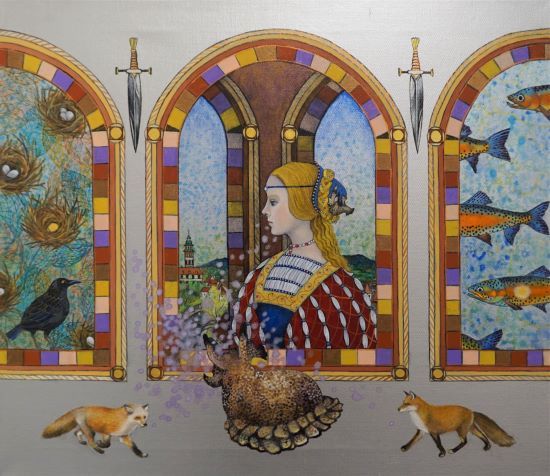
KIKUTA NAOMI
Rainy weather
2020
acrylic
Painting
H53 × W45.4 cm
Artist Profile
■ Biolgraphical Note
・Born in Kitakyushu city, Fukuoka, Japan
・Graduated from the Department of English and American literature , Tokyo Woman’s Christian University
・Completed MFA .Graduate School of Design,Kyushu University
■MONOGATARI
Folktales and stories are filled with mysterious events, often without clear logic, and at times even frightening. Yet, because they have been told with love, they have continued to offer people comfort, strength to live, and wisdom. That is why folktales have never disappeared and continue to be cherished.
When reading—or listening to—various stories, there are moments when a single sentence or even just one word captivates me, and an image suddenly rises to the surface. I wish to capture that fleeting moment and bring it onto the canvas.
Adding just the right amount of illustration to a story may help readers to slowly resonate with it, to spread the wings of their imagination. I hope people will find joy in quietly engaging with stories in this way.
With prayers that children all over the world may be surrounded by love, grow rich in spirit, and thrive in safety, I wish to share with you the world of my stories.
■KINGYOISM: (Kingyo is the Japanese word for goldfish)
People have bred kingyo from ancient times only to satisfy their own egocentric appreciation. Nevertheless, it is almost impossible to fix particular breeds, even though people have continued crossbreeding and the process of selection of specific mutational species. Kingyo happen to throw back ignoring people’s expectations. It is said that less than half of Kingyo grow as people want them to. Kingyo has lost its bodily habitus suitable for swimming because of people’s selfish breeding. Being forced to wear unnatural elegance, kingyo still refuses to be at the discretion of human beings. This must be a formidable Kingyo’s strategy (which is beyond the control of human beings).
People may think kingyo is just being watched, but it seems that kingyo meet people’s gaze squarely and gaze back straight from inside the aquarium or the countless small plastic bags hung from the eaves of pet shops. The moment when you feel so, you realize that it is rather human beings that are washed away by the flood of information, floating and drifting in the gigantic time and space.
If you sensed the gaze of kingyo, you could be enlightened by getting the feel of their eyes; then you must be able to feel, for even a moment, another self buried deep in everyday life that seems to pass automatically. Only through the kingyo’s eyes you will be able to see the true bonds with all life on earth and your ideal self.
■History and ecological characteristics of goldfish
There is a long history between human and goldfish. Red-colored Chinchui, which was found in the southern part ofChina about 1,700 years ago, is the original species of goldfish. Chinese people bred them in the ceramic bowls in the So period (about 400 years ago), and began to sort the varieties. Goldfish were introduced toJapan in the Muromachi period fromChina.
Goldfish have about 25 different varieties. There are two ways of breeding. One is by crossbreeding, and the other is by the artificial selections of the mutations. That goldfish have evolved from crucian carp has been proven by the morphological similarity, the same number and the type of the chromosomes, and the throwback by growing a pure culture. Each breed of goldfish has emerged in the relatively new age. Because of the instability of the gene, the selections are required to ensure the varietal characteristics. Many irregular forms appear even in the form of a tail fin that has been culled over the generations.
A tail fin analogous to that of crucian carp is called Funao, and nearly half of fry have this type of tail fin. Tsumami is another type that is also found in large numbers. Goldfish with these types of tail fin are unwanted; therefore you need selections to get rid of them. Body coloration starts to graduate from the initial crucian color to red or other colors about one month after hatching. Some of goldfish were improved to be viewed from the above and others were from the side.
○Jikin – Their epidermis is gradually destroyed by stripping the dorsal scales, and their color is changed by painting oxalic acid, glacial acetic acid, tartaric acid, salicylic acid, lime, and dilute hydrochloric acid. The shape of the tail fin is similar to a peacock. The probability of the emergence of this property is about 40 percent, if people select them for a long time.
○Choutengan – It is said that they were bred in deep ceramic bowls in the Qing court so the upper eyes have appeared.
○Ranchu – They lack the dorsal fin. Originally, this deficiency was caused by malformation. Ranchu has the curved and adhered spine. Because the tail is parallel to the axis of the body, it is clearly unsuitable for swimming. Only a handful of old fishes keep swimming smoothly.
○Tosakin – They have a warped tail that is inverted by crossbreeding and the appearance of the mutations. Young fishes are bred in the vessels like a mortar and forced to swim along the edge, and this unique tail is formed. They are not good swimmers and because of their sensitiveness to the water quality, it is very difficult to breed.
References
Matsui Yoshiichi:Kingyo , Hoikusya,1963
【 SOLO Exhibition 】
■ Art fair
・2014 Asia Contenporary Art Show(Hong Kong)
・2014 Art Kaouhsiung (Taiwan)
・2015 Affordable Art Fair Singapore (Singapore)
・2015 Asia Fukuoka Art Fair 2015(Fukuoka)
・2015 Art Kaouhsiung (Taiwan)
・2016 Art Kaouhsiung (Taiwan)
・2017 Asia Fukuoka Art Fair 2017(Fukuoka)
・2017Art Kaouhsiung (Taiwan)
・2018 Affordable Art Fair Hong Kong
・2018 Asia Fukuoka Art Fair 2018(Fukuoka)
■ Solo Exhibition
・2008/10 Naomi Kikuta Solo Exhibition, Goldfish Hour
Fukuoka Prefectural Museum of Art (Fukuoka)
・2012 /7 Naomi Kikuta Solo Exhibition, Cell
Reisen-Sou Renovation Museum (Fukuoka)
Panasonic Showroom, Mekiki Gallery (Fukuoka)
・2013/11 Naomi Kikuta Solo Exhibition, Rhizarians
Konya Gallery(Fukuoka)
・2014/2 Naomi Kikuta Solo Exhibition
Shonandai MY Gallery(Tokyo)
・2015/5 Naomi Kikuta Solo Exhibition
Shonandai MY Gallery (Tokyo)
・2016/7 Noomi Kikuta Solo Exhibition
Shonandai MY Gallery(Tokyo)
・2017/7 Naomi Kikuta Solo Exhibition
Gallery Ogata (Fukuoka)
・2018/4 Naomi Kikuta Solo Exhibition NELLA FANTASIA
Shonandai Gallery(Tokyo)
・2020/1 Naomi Kikuta Solo Exhibition FANTASIA,attoⅡ
s+arts (Tokyo)
■ Group Exhibition
・2011/11 Contemporary Art Exhibition 2011, Art League of Fukuokacity
Nishinihon City Bank Hall (Fukuoka)
・2011/11 Yotchan Biennale
Contemporary Art Center Osaka (Osaka)
・2011/02 Katayama laboratory exhibiton, School of Design, Kyushu University
Civic gallery, Fukuoka Art Museum (Fukuoka)
・2010/08 P & E2010 Group A
ARTCOURT Gallery Osaka (Osaka)
・2010/08 ART WAVE Fukuoka
Planning gallery, Asian Art Museum Fukuoka (Fukuoka)
・2010/02 Katayama laboratory exhibition,School of Design, Kyushu University
Civic gallery, Fukuoka Art Museum (Fukuoka)
・2009/10 Fukuoka City Art League Exhibition
Civic gallery,Fukuoka Art Museum (Fukuoka)
・2009/02 Katayama laboratory exhibition,School of Design,Kyushu University
Civic gallery, Fukuoka Art Museum (Fukuoka)
・2008/02 Contemporary Art Exhibition 2008, Art League of Fukuoka city
Nishinihon City Bank Hall (Fukuoka)
・2008/10 Fukuoka City Art League Exhibition
Special exhibition room A, Fukuoka Art Museum (Fukuoka)
・2008/10 The 24th Jonann-ku Art exhibition
Civic gallery,Fukuoka Art Museum (exhibition invitation) (Fukuoka)
・2008/01 The 5th Masuo Ikeda Memorial Art Exhibition
Ginza Yokyo Gallery (Tokyo)
・2008/03 The 5th Masuo Ikeda Memorial Art Exhibition
Contemporary Art Center (Osaka)
・2007/11 Contemporary Art Exhibition 2007, Art League ofFukuokacity
Gallery Maizuru (Fukuoka)
・2007/10 The 23th Jonan-ku Art exhibiton
Civic gallery,Fukuoka Art Museum (exhibition invitation) (Fukuoka)
・2007/10 Contemporary Art Exhibiton 2007, Art League of Fukuoka city
Nishinihon City Bank Hall (Fukuoka)
・2007/09 Fukuoka City Art exhibition
Special exhibition room A, Fukuoka Art Museum (Fukuoka)
・2007/06 The 1st Acrylic Art Award Exhibition 2007
Haradanomori Gallery, Hyogo Prefectural Museum (Grand Prize) (Kobe)
・2007/02 The 11th Liquitex Biennale Exhibition
Aoyama Spiral Garden (Tokyo)
・2006/11 The 22th Jonann-ku Art Exhibition
Civic gallery,Fukuoka Art Museum (exhibition invitation) (Fukuoka)
・2006/05 The 15th Shigeru Aoki Memorial Prize Exhibition
Ishibashi Museum of Art (Kurume,Fukuoka)
・2006/03 The 15th Shigeru Aoki Memorial Prize Exhibition
Koriyama City Museum (Fukushima)
・2006/01 The 4th Masuo Ikeda Memorial Art Exhibition (catalogs listing)
・2005/09 The 4th Shiobaru Project group Exhibition
Special exhibition room B, Fukuoka Art Museum (Fukuoka)
・2004/11 The 21th Jonan-ku Art Exhibition
Civic gallery, Fukuoka Art Museum (Mayor Award) (Fukuoka)
・2004/11 The 3rd Shiobaru Project group Exhibiton,
Special exhibition room B, Fukuoka Art Museum (Fukuoka)
・2003/11 The 2nd Shiobaru Project group Exhibition
IMS-Iris Gallery (Fukuoka)
・2003/03 The 1st Shiobaru Project group Exhibition
Fukuoka Asian Art Museum (Fukuoka)
Gallery Ogata Ltd.
Detail- SECTION :
- Galleries
- BOOTH :
- W50
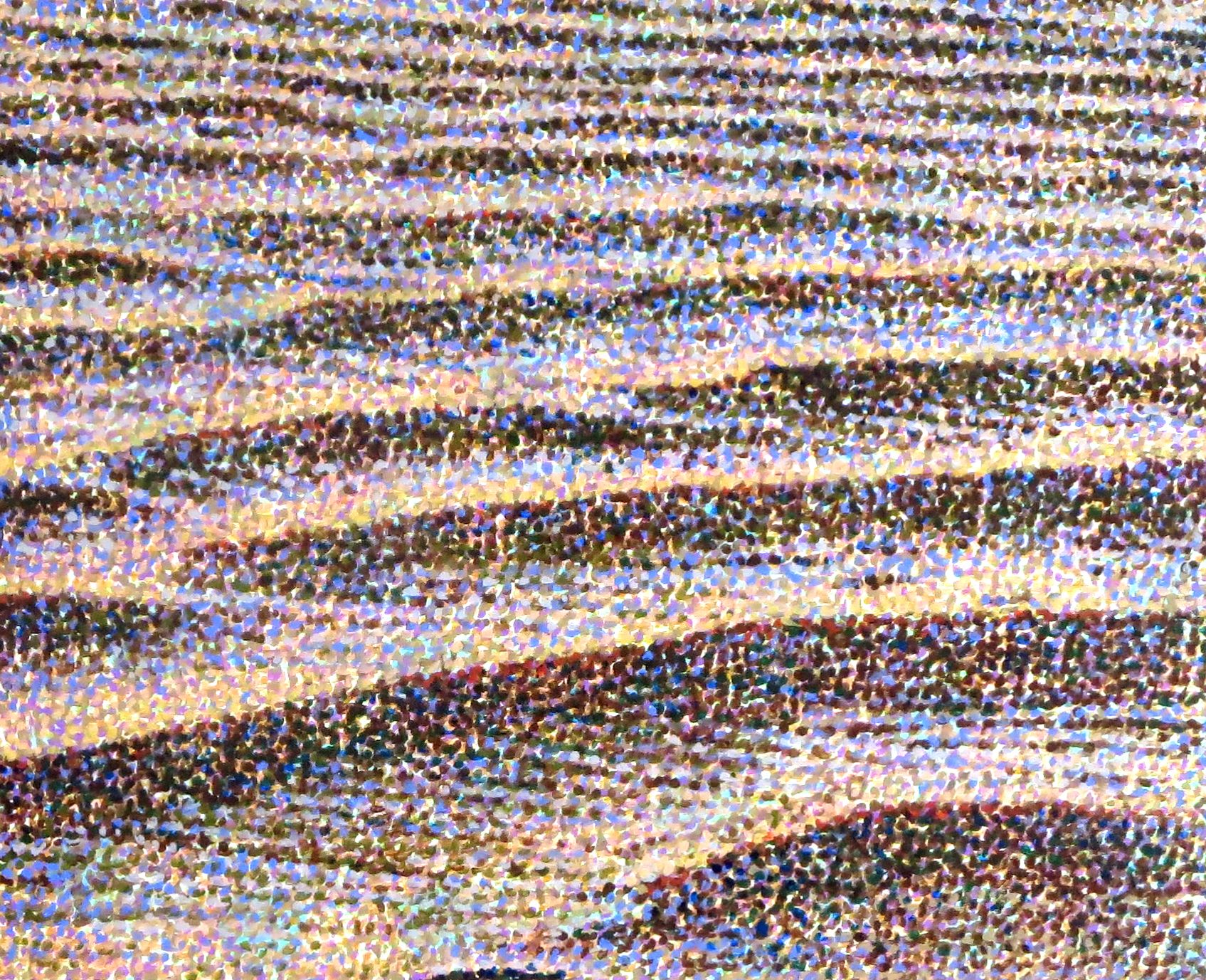
Nao Sano
Sea of Sand
2025
Oil paint, acrylic, cotton canvas
Painting
H22 × W27.3 cm
Artist Profile
熊本の若手作家で点描で制作されて幅広い人気があります。
Gallery Ogata Ltd.
Detail- SECTION :
- Galleries
- BOOTH :
- W50
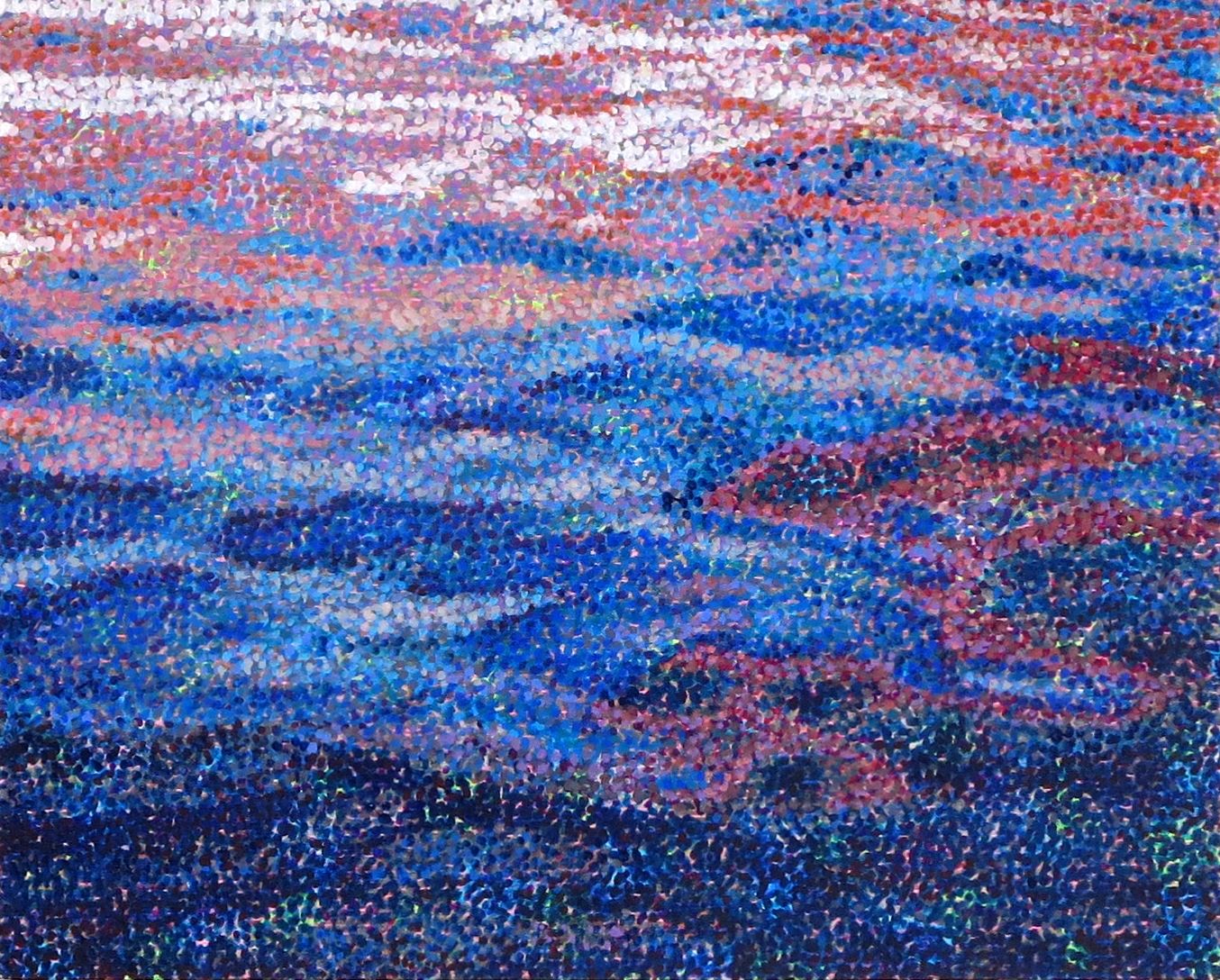
Nao Sano
pale red
2024
Oil paint, acrylic, cotton canvas
Painting
H22 × W27.3 cm
Artist Profile
熊本の若手作家で点描で制作されて幅広い人気があります。
Gallery Ogata Ltd.
Detail- SECTION :
- Galleries
- BOOTH :
- W50
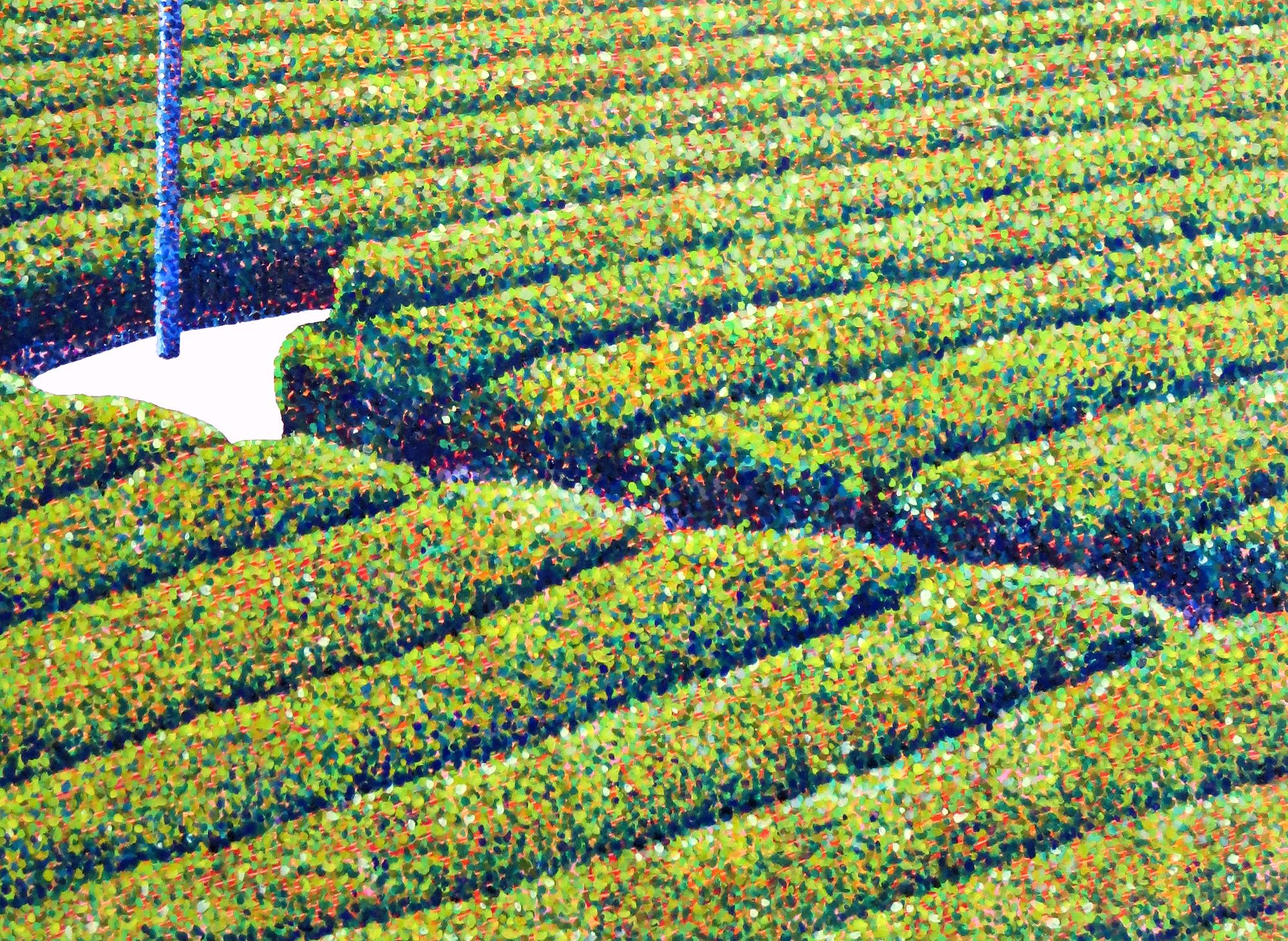
Nao Sano
PLANTATION
2025
Oil paint, acrylic, cotton canvas
Painting
H24.2 × W33.3 cm
Artist Profile
熊本の若手作家で点描で制作されて幅広い人気があります。
Gallery Ogata Ltd.
Detail- SECTION :
- Galleries
- BOOTH :
- W50
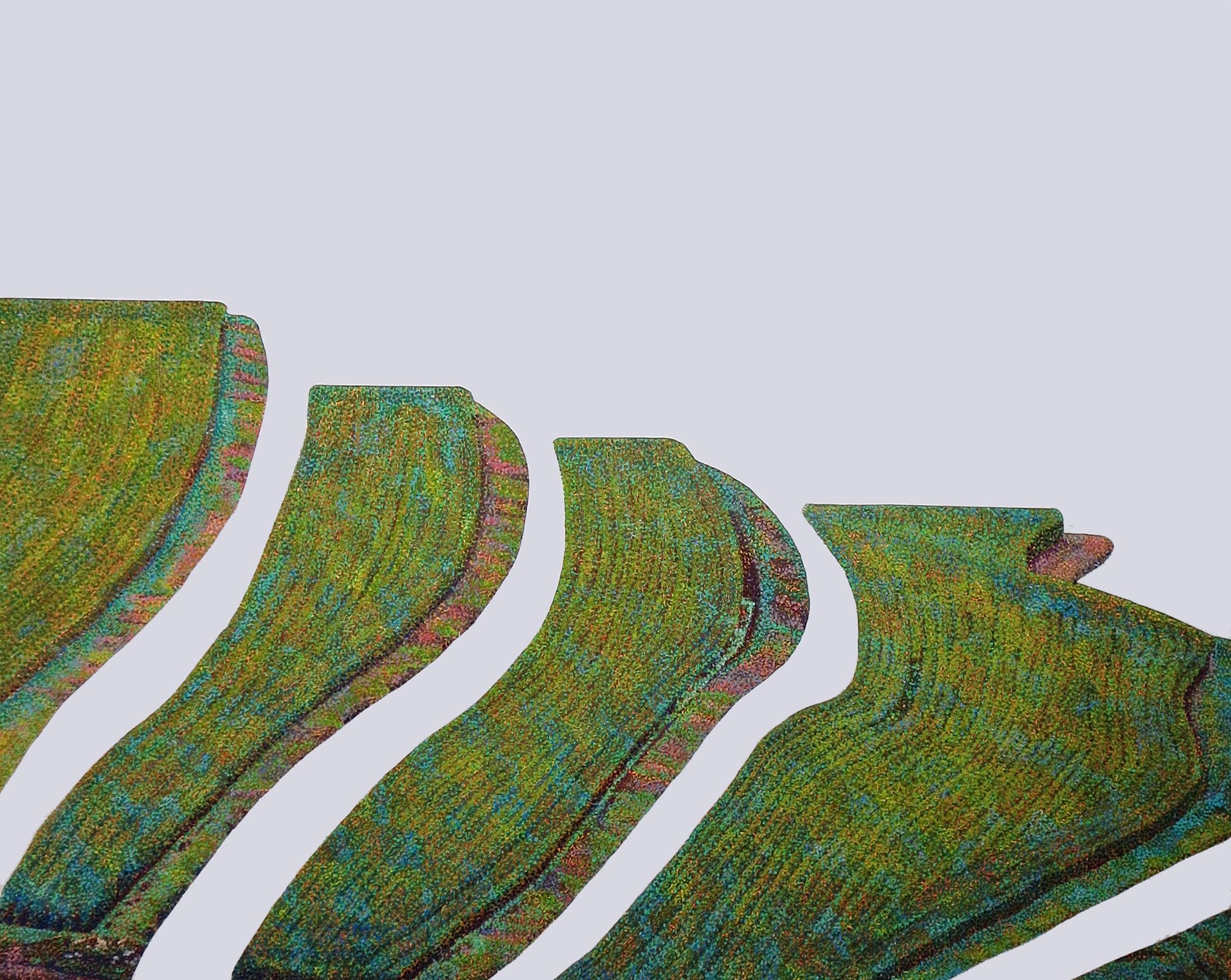
Nao Sano
field 1
2023
Oil paint, acrylic, cotton canvas
Painting
H72.2 × W91 cm
Artist Profile
熊本の若手作家で点描で制作されて幅広い人気があります。
Gallery Ogata Ltd.
Detail- SECTION :
- Galleries
- BOOTH :
- W50
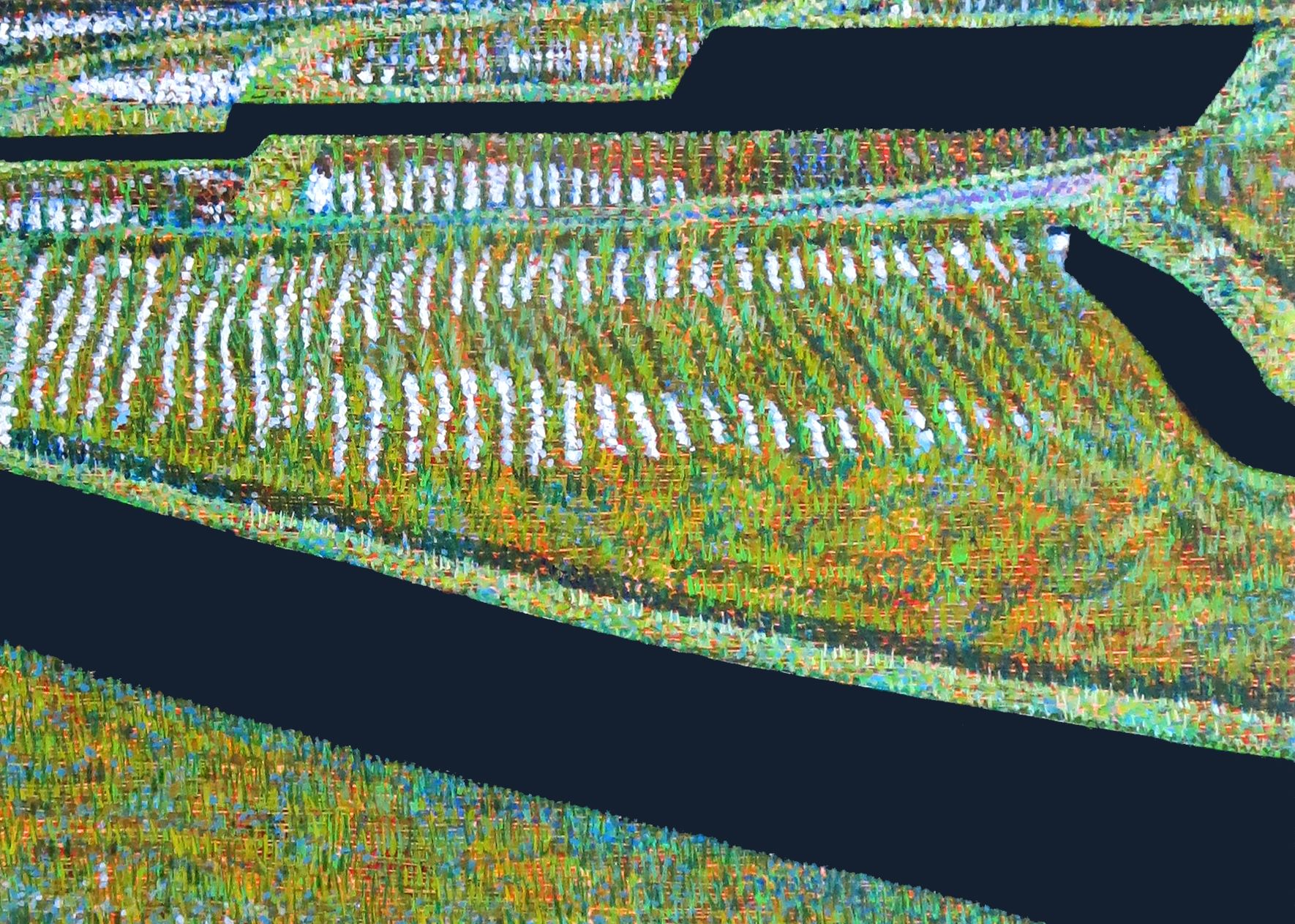
Nao Sano
Field 2
2024
Oil paint, acrylic, cotton canvas
Painting
H24.2 × W33.3 cm
Artist Profile
熊本の若手作家で点描で制作されて幅広い人気があります。
Gallery Ogata Ltd.
Detail- SECTION :
- Galleries
- BOOTH :
- W50

Nao Sano
WIND
2022
Oil paint, acrylic, cotton canvas
Painting
H91 × W116.7 cm
Artist Profile
熊本の若手作家で点描で制作されて幅広い人気があります。
Gallery Ogata Ltd.
Detail- SECTION :
- Galleries
- BOOTH :
- W50